What is your refund policy?
Any planned and paid service that does not take place as planned will be refunded. Any session started, even partially, is non-refundable. Any software license or educational material you choose to purchase for your own use is your responsibility and non-refundable.
If I miss a session, what happens?
You can cancel or reschedule a session up to one hour before the appointment. Refunds for missed sessions are considered on a case-by-case basis, taking into account the circumstances and good faith.
Do I have to pay for each session separately?
You can pay per session, or choose a weekly or monthly subscription so that sessions are debited automatically from a chosen date. This can be set up directly from the booking screen by selecting the available packages.
Can I come accompanied?
Sessions are personal and confidential. You may have a third person with you if that helps you feel safer, but they must remain silent and not interfere with the process.
Are sessions recorded?
The first introductory session may be recorded, with your consent, to support the organization of future sessions. This recording is shared only with you, and you decide what to do with it. The following sessions are not recorded, and you are free to choose your preferred contact mode.
Do I have to use a webcam?
For the first session, yes, so we can meet each other properly. Afterwards, you may choose whether to keep your camera on or off, depending on what feels safest and most comfortable for you.
How do I watch your online sessions?
Brief therapy and personal development sessions are confidential. You cannot join or listen in on them.
However, I do share free content on my Substack space, where you can find insights, tips, and guidance on personal growth, emotional resilience, and mindset development.
Respect for the dignity and privacy of clients is an important value here.
What is Sophro-Analysis?
Sophro-analysis is a brief therapy combining sophrology techniques and psychotherapeutic work to revisit significant events from the past and access the unconscious through images and body awareness, in order to release beliefs, emotions, and repetitive patterns and achieve lasting results.
Is this therapy?
It depends entirely on your needs.
Therapy is a structured process where a trained professional helps a person (or group) explore emotions, thoughts, behaviors, or experiences to alleviate distress, promote healing, and foster personal growth. It provides a safe, confidential space to address challenges like mental health struggles, trauma, relationship issues, or existential questions, using evidence-based techniques tailored to each one's needs.
Some countries have tried to regulate the use of the term "therapy" to reserve it for psychotherapists and manipulate public opinion and attempt to regulate the coaching industry, which is not the same as psychotherapy. In the context of LGS Solutions, we offer a range of services that include therapeutic elements, but we do not claim to provide formal therapies regulated via licensed professionals in accordance with local regulations.
To have a clearer picture of the difference between coaching and therapy, you can read this article on the Substack space: Therapy vs Coaching: Understanding the Differences.
We provide coaching and support that can be therapeutic in nature that we often call "healing" or "briefs therapies" for convenience.
Some sessions focus on emotional healing, others on mindset and personal growth, others on skill development. Other types of sessions focus on more technical matters such as business process improvement.
More answers about coaching
What if I get overwhelmed by emotion during a session?
Strong emotions are welcome here. If you cry, feel hot or cold, need silence, or feel confused for a moment, it’s okay. We will slow down, ground, and support your nervous system together. You are not expected to “hold it together”.
Do you use hypnosis in your sessions?
Each case is unique and each protocol is entirely personalized. Some clients may benefit from incorporating NLP and hypnotherapy tools into their journey if they wish.
This is done in a transparent manner and always with the client's approval.
Do you work with all twelve Caycedian levels?
Sophrology's 12 degrees of dnamic relaxation (RD) are structured into three cycles, each designed to meet you where you are and guide you toward deeper self-awareness, resilience, and harmony.
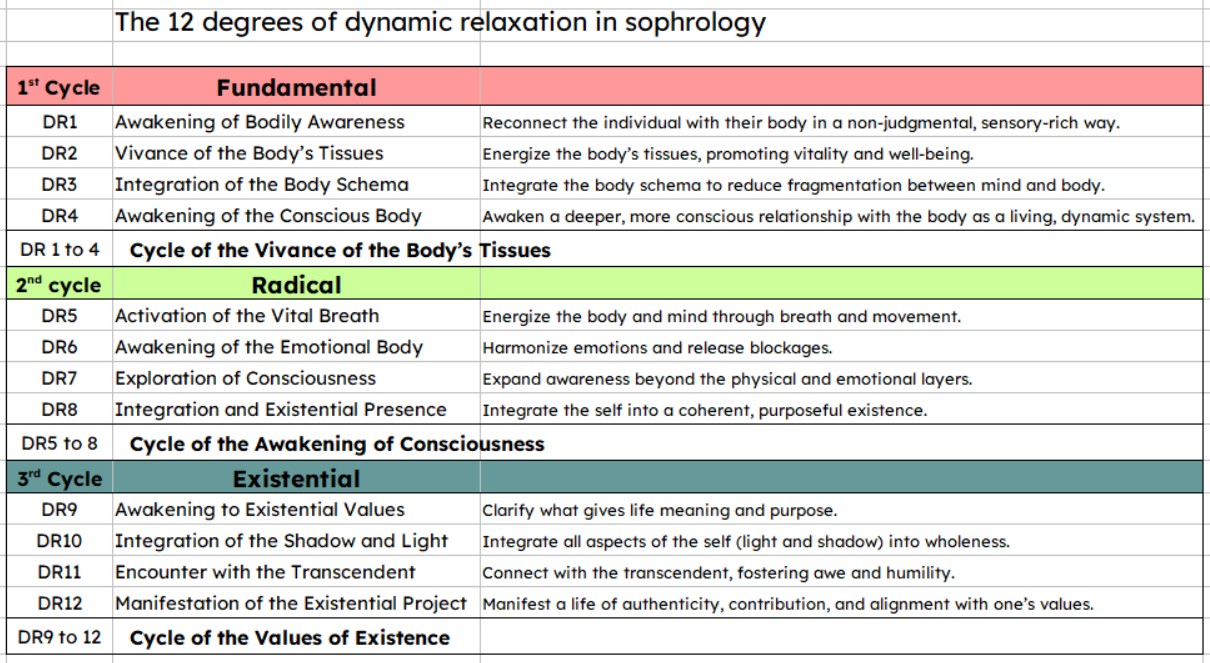 The First Cycle (degrees 1-4) focuses on awakening bodily awareness and grounding techniques—ideal for those reconnecting with themselves after trauma, burnout, or neurodivergent challenges. These practices are foundational, gentle, and accessible, helping you rebuild trust in your body and mind.
The Second Cycle (degrees 5-8) dives into emotional regulation, mental clarity, and projective techniques, empowering you to reframe limiting beliefs and cultivate a more balanced perspective.
Finally, the Third Cycle (degrees 9–12) explores existential values, purpose, and consciousness expansion, offering tools for those seeking deeper meaning or preparing for life transitions.
At LGS Solutions, I prioritize the First Cycle in my content because its practices are universally accessible and particularly impactful for autistic individuals and trauma survivors—helping them gradually reclaim agency over their bodies and minds. However, my work extends across all three cycles, with somatic-based protocols tailored to each stage.
Whether you’re here to ground yourself, reframe your mindset, or explore existential questions, I meet you with practical, science-aligned methods—no gurus, no dogma, and no pressure to conform to any ideology. My role is to guide you safely, respecting your values and pace, so you can integrate mindfulness in your life, in a way that feels authentic to you.
What should I prepare before a session?
Plan a quiet space where you won’t be disturbed, a comfortable seat, some water, and tissues if you wish. Allow at least one hour and a half in your schedule so you don’t have to rush afterwards.
What is YOGASophro?
YOGAsophro® is a method combining yoga and sophrology, created by Mila RIVAULT, author of the book Stress post-traumatique (Post-Traumatic Stress), published by Editions Leduc.
It is a holistic approach to well-being that integrates physical postures, breathing techniques, relaxation exercises, and visualization to promote mental and emotional balance.
YOGAsophro® is designed to help you manage stress, improve sleep, enhance concentration, and cultivate a deeper connection between the body and mind.
When we develop a strategy aimed at improving your well-being or achieving your goal, YOGAsophro® sessions can be included in your progress path.
They are tailored to your body type, your physical and mental state, your preferences and feelings, and they reflect who you are.
These are precious moments of deep reconnection with yourself that are not shared in a group setting.
What equipment do I need to buy to follow YogaSophro sessions?

No equipment is mandatory, but it is highly recommended that you purchase small items to make the poses more comfortable and adapt them to your needs, morphology and desires.
Somatic practices are most effective when they are personalized and adapted to your current body state and energy levels. In all cases, you should keep them comfortable and accessible to be able to focus on deep inner works rather than on postures perfection. You can start with what you have and gradually acquire the items that feel right for you.
- A yoga mat
- A bolster
- Two to four blocks
- Two to four comfortable cushions with multiple layers
- Two large thick towels
- A buckled loop strap
- A long resistance band
- A yoga chair
How do I know when I’m “healed”?
Healing is not a finish line. Often, we notice we are healing when we no longer need crisis to take care of ourselves, when we feel more curious than afraid about our inner world, and when self-care becomes a natural part of our life rather than an emergency measure.
Taking care of yourself through brief-therapy sessions allows you continue stepping forwards with your life instead of staying stuck and miserable.
It is when getting closer to your goals and moving on with your life that some day you pause and realise that you aren't dysfunctioning anymore as you used to.
More answers about coaching
How do you heal trauma?
Each person is unique, and the protocol used is tailored to fit individual needs.
Lætitia will listen to you attentively and offer tools that are suited to your specific context.
Some people will only need a few long conversations, while others may require follow-up that is more or less frequent and of varying duration.
In all cases, your progress, which remains confidential, will be regularly measured, documented, and reassessed to ensure effective support.
Self-compassion is a powerful approach to recovering from childhood or intergenerational trauma.
It is based on the principles of healing through intra-personal explorations, forgiveness, and releasing emotional blockages.
It perfectly complements a mindfulness care protocol.
As soon as you feel ready to start your healing journey, contact me to discuss how I can support you in this process.
Are you also teaching how to heal?
I do not offer online courses on the techniques and methods I use while working.
During a session, I do take the necessary time to explain in details what I do and teach you a few basics of the methods used, just enough for you to continue practicing on your own at home.
After your sessions are complete, if you wish to continue learning with me, you are free to book more sessions that we'll dedicate to your progress.
More answers about coaching